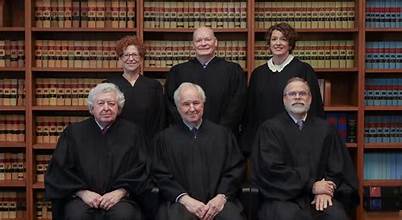
The Kansas Supreme Court will conduct a special session Tuesday, September 22, at Liberal High School in Liberal. Doors open at 5:30 p.m. A brief informational session before oral argument will start about 6:15 p.m and run to 6:30 p.m.
From 6:30 to about 7:30 p.m. the Supreme Court will be in session to hear oral arguments in one case. After oral argument, justices will greet the public in an informal reception.
The case to be heard is:
Appeal No. 127,854: State of Kansas (Appellee) v. Douglas Moser (Appellant)
Harvey County: (Petition for Review) A Harvey County sheriff’s deputy stopped Moser for a seat belt violation after he got a message from a detective that there was an outstanding warrant for Moser’s passenger. While the sheriff’s deputy verified Moser’s license, registration, and insurance, the passenger admitted to the detective who was now at the scene that he was carrying drugs. When the deputy heard this, he asked Moser to exit the vehicle so he could search it. Before the search, he did a weapons pat-down of Moser and found what felt like a needle, which he confirmed when he removed it from Moser’s pocket. The deputy did not find incriminating evidence in Moser’s vehicle. He arrested Moser for possession of drug paraphernalia. After placing him under arrest, the deputy found Moser had a box with crystals in it, later confirmed to be methamphetamine. A jury found Moser guilty of possession of a controlled substance. The district court denied Moser’s motion for a new trial.
On appeal Moser claims: 1) law enforcement unconstitutionally extended the scope of his traffic stop; 2) law enforcement unconstitutionally conducted a pat-down because the alleged consent was not valid and there was no reasonable suspicion that he was armed and dangerous; 3) law enforcement unconstitutionally removed a needle from his pocket by failing to meet the plain view or plain feel exception to the warrant requirement; 4) his arrest and seizure of evidence was unconstitutional because there was no probable cause of criminal activity particular to Moser; and 5) trial counsel provided ineffective assistance. The Court of Appeals affirmed. The Supreme Court granted Moser’s petition for review on his first four issues.


